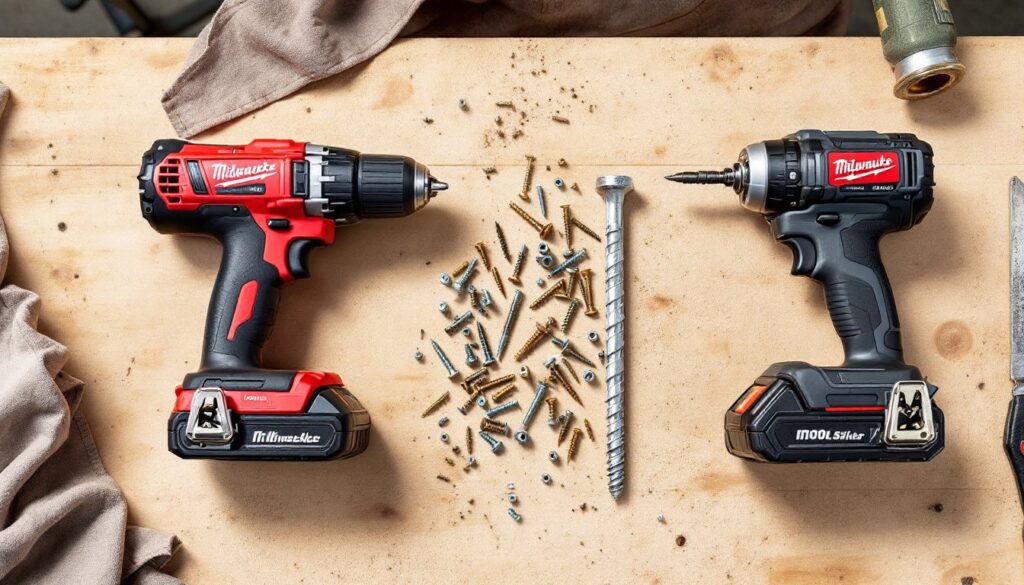

If you’ve stood in a tool aisle wondering whether to grab a drill or an impact driver, you’re not alone. Both tools look similar, both spin bits, and both promise to save you time and effort. But they work in fundamentally different ways, and choosing the wrong one for a job wastes money and frustration. The truth is simpler than you might think: most homeowners benefit from owning both, though one might be all you need to start. Understanding the distinctions helps you work smarter, faster, and with better results on everything from hanging shelves to assembling furniture to tackling serious construction projects.
Key Takeaways
- A drill delivers steady, continuous rotational force ideal for precision work like drilling holes and assembly, while an impact driver uses rapid concussive bursts of force (1,000–3,000 impacts per minute) to handle tough fastening in dense materials.
- Impact drivers generate significantly more torque (1,000–2,500+ ft-lbs) compared to drills (300–500 ft-lbs), making them superior for heavy-duty tasks like deck building, fence installation, and removing corroded fasteners without straining the motor.
- Most homeowners should start with a cordless drill ($80–$200) for its versatility and affordability, then add an impact driver ($100–$250) once projects demand its aggressive fastening power.
- An impact driver excels at high-volume fastening and reduces wrist fatigue through impact force, while a drill provides better control for delicate materials, assembly work, and applications requiring precision.
- Owning both tools with a matching battery system maximizes performance and project capability, though a quality drill alone handles over half of typical homeowner tasks effectively.
Understanding the Basic Differences
A drill and an impact driver share the same basic goal, turn a bit or fastener, but they achieve it through completely different mechanisms. Think of a drill as a steady, continuous power tool. It spins the bit smoothly in a circular motion, much like an old hand-crank drill your grandfather might have used. An impact driver, by contrast, delivers rapid, concussive bursts of force plus to rotation. It’s like the difference between pushing a screw in smoothly versus tapping it in with a mallet while you twist.
How Each Tool Works
A drill uses a motor connected directly to a chuck that grips the bit. Power flows constantly, and the bit rotates at a steady speed. When you apply downward pressure, the motor works harder to overcome resistance, but the bit still rotates in a single, continuous motion. Most consumer drills run between 300 and 3,000 RPM (revolutions per minute), depending on the model and gear setting.
An impact driver uses a different internal mechanism. Inside the housing is a weighted cam or anvil that rotates slightly out of sync with the main motor shaft. As the bit encounters resistance, this mechanism suddenly impacts the chuck, delivering a sharp, quick burst of rotational force. This happens dozens of times per second, creating that distinctive tapping sound you hear. Impact drivers typically deliver 1,000 to 3,000 impacts per minute (IPM), layered on top of rotational force. The result is aggressive fastening power that helps the bit bite into tough materials without bogging down the motor.
Imagine driving a screw into hard wood. A drill will spin steadily, and as the screw digs in, the motor works harder and harder. An impact driver, sensing that resistance, fires off rapid impacts that help the screw advance with less strain on both the tool and your wrist.
Power and Torque: What Sets Them Apart
Torque, the rotational force a tool delivers, is where drills and impact drivers diverge most noticeably. Torque is measured in foot-pounds (ft-lbs) or newton-meters (N-m). A mid-range cordless drill typically delivers 300–500 ft-lbs of torque. A comparable impact driver cranks out 1,000–2,500+ ft-lbs. That’s a massive difference, and it’s why impact drivers excel at heavy-duty fastening.
But high torque alone doesn’t tell the whole story. A drill delivers its torque steadily and continuously. If you hit a snag, a tough knot in wood, a hard material, the motor struggles. Your wrist absorbs the resistance. The chuck can slip. An impact driver’s bursts of force overcome stubborn resistance without straining the motor or your arm. The impacts do the heavy lifting.
Speed, measured in RPM, also differs. Drills spin faster, up to 3,000 RPM on some models, making them efficient for general fastening in softer materials. Impact drivers usually top out around 1,500–2,000 RPM because they don’t need raw speed: the impacts compensate. When you’re driving a fastener into thick oak or into existing masonry, raw RPM isn’t your bottleneck. Sheer force is. That’s where the impact driver shines. Tools designed for driving screws highlight how impact drivers handle tough jobs that would leave a standard drill struggling.
Versatility and Best Use Cases
Neither tool is inherently “better”, context determines which one you reach for. The key is understanding what each tool is built to handle.
When to Choose a Drill
Use a drill when you need precision, control, and moderate power. Drilling holes ranks high on the list. A drill’s variable speed control and steady rotation let you start a hole without the bit skating across the surface. You control the feed rate, how quickly the bit advances, which matters when boring through drywall into a stud or when you’re working with delicate materials like tile or trim.
Assembly work is another drill stronghold. Driving fasteners into particle board, soft wood, or plastic hinges demands a light touch. An impact driver’s aggressive impacts can strip screws or crush fiberboard. Installing shelves, mounting cabinet doors, or hanging a towel rack? Reach for the drill. It’s also gentler when driving fasteners by hand if you’re building furniture or making adjustments where you want feel and feedback. Drills typically cost $80–$150 for a solid cordless model, making them a budget-friendly starting point.
When to Choose an Impact Driver
Grab an impact driver when you’re dealing with heavy-duty fastening, dense materials, or high volume. Deck building, fence installation, and framing work are classic impact driver jobs. Driving 3-inch deck screws into pressure-treated lumber or fastening doubled-up joists? The drill will bog down: the impact driver handles it effortlessly.
Corrosion, rust, and seized fasteners are another category. Removing a rusted bolt or a stripped screw demands aggressive force that a drill can’t reliably deliver without motor burnout. Impact drivers excel here because the impacts break corrosion and help the bit grip. Auto work, appliance repair, and demolition frequently call for an impact driver.
Volume fastening, hanging drywall, installing hundreds of screws for a subfloor, favors the impact driver. The impacts reduce fatigue on your wrist and shoulder, and the tool works faster. A professional carpenter or contractor doing this work daily will tell you an impact driver pays for itself in saved time and reduced strain. Sources like Popular Mechanics and Bob Vila regularly recommend impact drivers for serious home improvement projects where power and endurance matter.
Cost, Weight, and Practicality for Homeowners
Budget and portability influence the choice significantly. A quality cordless drill costs $80–$200, while a comparable impact driver runs $100–$250. If you’re starting fresh, a drill is the smarter first purchase. It does more than half the jobs most homeowners face. Add an impact driver when you identify projects that need it, deck building, fence work, or heavy fastening.
Weight matters too. A typical drill weighs 3.5–4.5 pounds without battery. An impact driver runs 2.5–3.5 pounds, making it slightly lighter and easier to use overhead or in tight spaces. The impact driver’s compact design is a win for awkward positions, though the difference is modest.
Most homeowners benefit from owning both tools, but if budget or space is tight, start with a drill. Many modern drill-driver combos are competent at both tasks, though they’re masters of neither. If you can swing it, a dedicated drill and a dedicated impact driver give you the best performance for the money. Buy a matching battery system so batteries interchange, this reduces redundant investment and keeps your options open.
Maintenance is minimal for either tool. Keep batteries charged, store them in a cool, dry place, and wipe dust out of the motor vents occasionally. A worn or damaged chuck can be replaced on most corded models, but cordless tools are often cheaper to replace than repair.